
Gustav Mahler
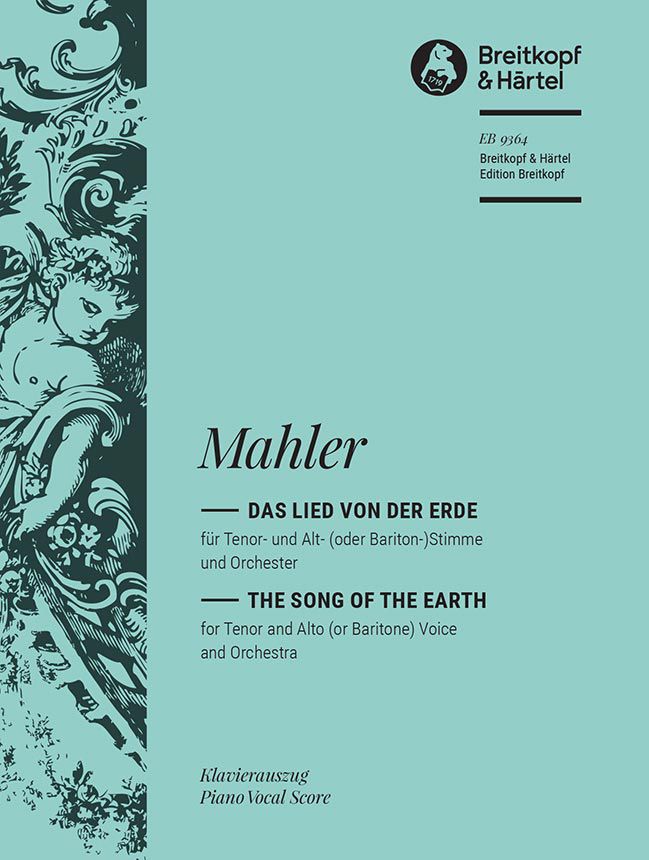
The Song of the Earth
for Tenor and Alto (or Baritone) Voice and Orchestra
PDF
vista
Gustav Mahler
The Song of the Earth
for Tenor and Alto (or Baritone) Voice and Orchestra
- Formazione solisti (TA) e orchestra
- Formazione opzionale solisti (TB) e orchestra
- Compositore Gustav Mahler
- Editore Christian Rudolf Riedel
- Edizione riduzione per pianoforte
- Casa Editrice Breitkopf & Härtel
- Numero d'ordine EB9364
 disponibile
sarà spedito in 1-2 giorni lavorativi
IVA inclusa,
Escluse le spese di spedizione
Non disponibile in tutti i Paesi. Saperne di più

Descrizione:
The Song of the Earth, composed in the summer of 1908, is Mahler's best-known and most personal work. Reflecting drastic changes in his life, its immense emotional density is very moving. Until the very end, Mahler continued to refine the extremely differentiated instrumentation, as is evident in numerous retouchings in the autograph score and engraver's model. It is therefore all the more regrettable that he was neither able to perform his 'Symphony in Songs' himself nor that he was involved in its printing. Unfortunately, in the posthumously published first edition of 1912 and the subsequent editions edited by Erwin Ratz and Karl Heinz Füssl, many questions remained unanswered, while other were answered in a dubious way.
The edition is the first text-critical one of the work on a scientifically sound basis. It offers not only a more reliable musical text, but also systematically and lucidly prepared information on the sources, their transmission and evaluation. All editorial decisions have been documented in a transparently comprehensible manner - in particular those leading to new audible results. Work-related notes on performance practice, which for the first time include Mahler's conducting indications, offer valuable, indispensable interpretive aids. In addition to the regular five clarinet parts, the set of parts includes two additional parts (3rd clarinet/Eb clarinet, bass clarinet/3rd clarinet in places where the latter plays Eb clarinet) to allow performances with only four clarinets.
The completely revised piano reduction reproduces the orchestral texture true to the score without losing sight of playability. Both Mahler's piano autograph and the piano reduction by Wöss, which was commissioned by the composer himself, served as an inspiration for this.
The edition is the first text-critical one of the work on a scientifically sound basis. It offers not only a more reliable musical text, but also systematically and lucidly prepared information on the sources, their transmission and evaluation. All editorial decisions have been documented in a transparently comprehensible manner - in particular those leading to new audible results. Work-related notes on performance practice, which for the first time include Mahler's conducting indications, offer valuable, indispensable interpretive aids. In addition to the regular five clarinet parts, the set of parts includes two additional parts (3rd clarinet/Eb clarinet, bass clarinet/3rd clarinet in places where the latter plays Eb clarinet) to allow performances with only four clarinets.
The completely revised piano reduction reproduces the orchestral texture true to the score without losing sight of playability. Both Mahler's piano autograph and the piano reduction by Wöss, which was commissioned by the composer himself, served as an inspiration for this.
-
1. Das Trinklied vom Jammer der Erde
-
2. Der Einsame im Herbst
-
3. Von der Jugend
-
4. Von der Schönheit
-
5. Der Trunkene im Frühling
-
6. Der Abschied
I clienti hanno valutato questo prodotto:
Informazioni del Produttore:
Breitkopf & Härtel KG
Walkmühlstraße 52
65195
Wiesbaden
Deutschland
Prodotti correlati:
- solista e orchestra
- partitura
- Breitkopf & Härtel
-
sarà spedito in 2-5 giorni lavorativi
- solista e orchestra
- partitura
- Breitkopf & Härtel
-
sarà spedito in 2-5 giorni lavorativi
- solista e orchestra
- set di parti
- Breitkopf & Härtel
-
sarà spedito in 2-5 giorni lavorativi
- solista e orchestra
- parte violino 1
- Breitkopf & Härtel
-
sarà spedito in 2-5 giorni lavorativi
- solista e orchestra
- parte violino 2
- Breitkopf & Härtel
-
sarà spedito in 2-5 giorni lavorativi
- solista e orchestra
- parte viola
- Breitkopf & Härtel
-
sarà spedito in 2-5 giorni lavorativi
- solista e orchestra
- parte violoncello
- Breitkopf & Härtel
-
sarà spedito in 2-5 giorni lavorativi
- solista e orchestra
- parte contrabbasso
- Breitkopf & Härtel
-
sarà spedito in 2-5 giorni lavorativi