
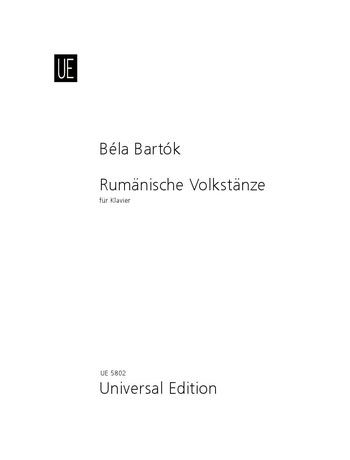
Béla Bartók
Rumanian Folk Dances
PDF
vista
Béla Bartók
Rumanian Folk Dances
- Formazione pianoforte
- Compositore Béla Bartók
- Editore Péter Bartók
-
Difficoltà
- Edizione spartiti
- Casa Editrice Universal Edition
- Numero d'ordine UE5802
 disponibile
sarà spedito in 1-2 giorni lavorativi
IVA inclusa,
Escluse le spese di spedizione
Non disponibile in tutti i Paesi. Saperne di più
Descrizione:
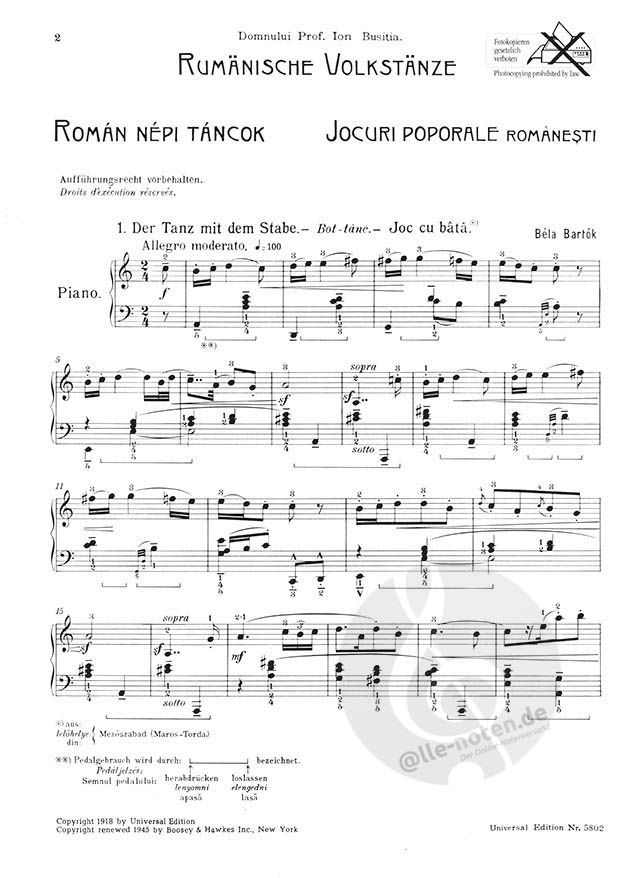
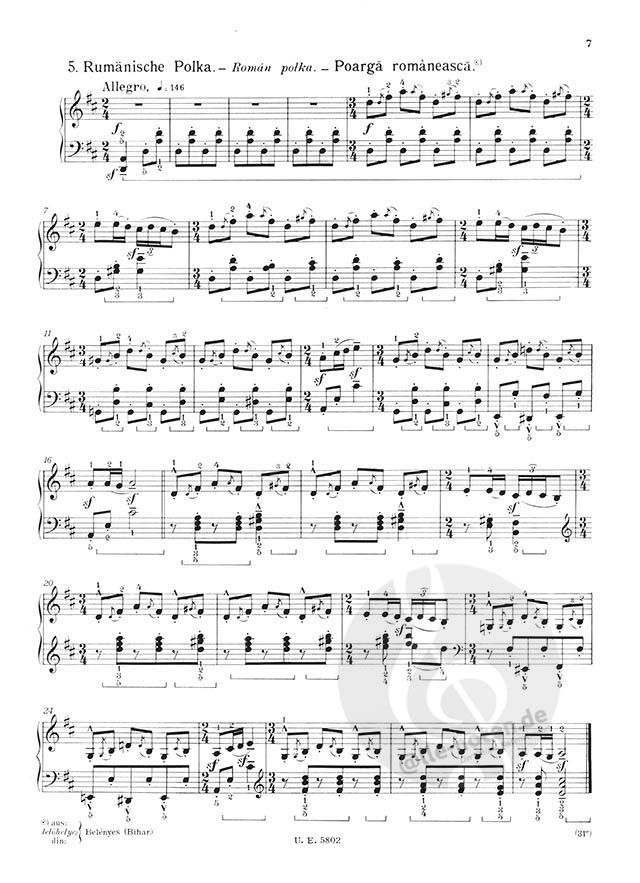
The 'Romanian Folk Dances' undoubtedly rank amongst Bartók's most popular compositions. The earliest version is scored for piano (1915) and was published by Universal Edition in 1918.
ln the preparation of this revised edition the last previous printed edition was compared with the available manuscript sources, which include editions marked by Béla Bartók with corrections. His corrected copies of the violin-piano transcription (prepared by Zoltán Székely), as well as the orchestra arrangement, were also considered.
The major correction concerns metronome numbers. At various times since the work's first publication the composer slightly revised some of these tempi. ln the composer's lifetime the last printed editions of both violin-piano and piano versions, produced during World War II, bear corrections in his file copies, the two being in agreement with each other as well as with the marked duration of each dance. The tempi found in these printed editions, believed to be the composer's last word on the subject, appear in this revised edition.' (Peter Bartók)
ln the preparation of this revised edition the last previous printed edition was compared with the available manuscript sources, which include editions marked by Béla Bartók with corrections. His corrected copies of the violin-piano transcription (prepared by Zoltán Székely), as well as the orchestra arrangement, were also considered.
The major correction concerns metronome numbers. At various times since the work's first publication the composer slightly revised some of these tempi. ln the composer's lifetime the last printed editions of both violin-piano and piano versions, produced during World War II, bear corrections in his file copies, the two being in agreement with each other as well as with the marked duration of each dance. The tempi found in these printed editions, believed to be the composer's last word on the subject, appear in this revised edition.' (Peter Bartók)
-
Der Tanz mit dem Stabe / Joc cu bâta
-
Brâul
-
Der Stampfer / Pe loc
-
Poarga româneasca * Schnell-Tanz
-
Maruntel
-
Schnell-Tanz / Maruntel
I clienti hanno valutato questo prodotto:
Informazioni del Produttore:
Universal Edition AG
Karlsplatz 6
1010
Wien
Österreich
Altri clienti hanno acquistato anche:
Aaron Copland
- pianoforte
- spartiti
- Jane Magrath
-
disponibile
sarà spedito in 1-2 giorni lavorativi - Disponibile anche per il download!
Johann Sebastian Bach
- pianoforte
- spartiti (urtext)
-
disponibile
sarà spedito in 1-2 giorni lavorativi

- pianoforte
- spartiti
-
disponibile
sarà spedito in 1-2 giorni lavorativi
23 Stücke für Klavier vierhändig (Schott Piano Classics)
- pianoforte a 4 mani
- spartiti
-
disponibile
sarà spedito in 1-2 giorni lavorativi - Disponibile anche per il download!

- pianoforte
- spartiti
-
disponibile
sarà spedito in 1-2 giorni lavorativi

- pianoforte a 4 mani
- spartiti
-
disponibile
sarà spedito in 1-2 giorni lavorativi

- pianoforte a 4 mani
- spartiti
-
disponibile
sarà spedito in 1-2 giorni lavorativi

- pianoforte
- spartiti (urtext)
- Christian Ubber
-
disponibile
sarà spedito in 1-2 giorni lavorativi

Johann Friedrich Burgmüller
- pianoforte
- spartiti
-
disponibile
sarà spedito in 1-2 giorni lavorativi

- pianoforte
- spartiti
-
disponibile
sarà spedito in 1-2 giorni lavorativi

23 Pieces for Piano Duet
- pianoforte a 4 mani
- spartiti
-
disponibile
sarà spedito in 1-2 giorni lavorativi - Disponibile anche per il download!
- pianoforte a 4 mani
- spartiti
-
disponibile
sarà spedito in 1-2 giorni lavorativi

Carl Czerny
Preparatory Method for the School of Velocity for Piano Op. 299
- pianoforte
- spartiti
-
disponibile
sarà spedito in 1-2 giorni lavorativi
- pianoforte a 4 mani
- spartiti
-
disponibile
sarà spedito in 1-2 giorni lavorativi






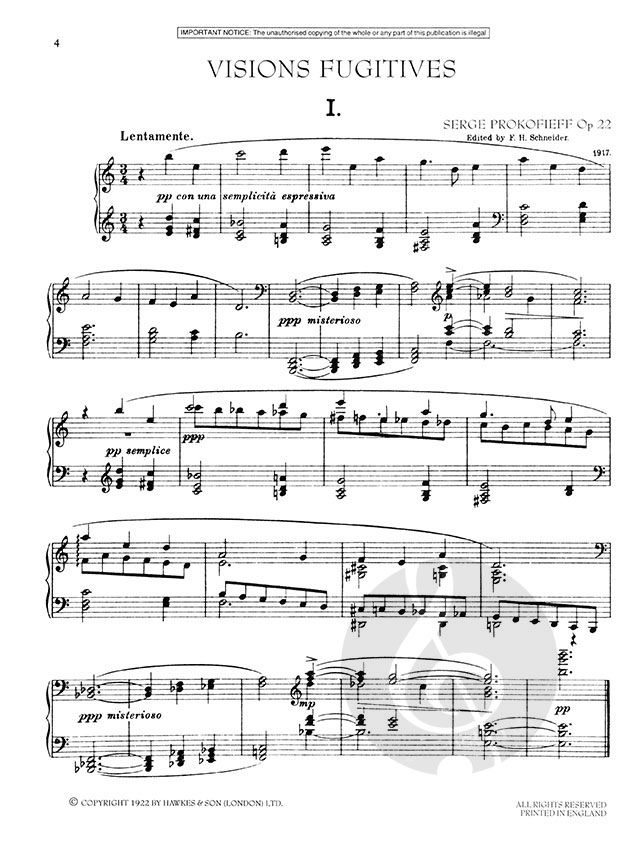
Sergei Prokofjew
- pianoforte
- spartiti
- F.H. Schneider
-
disponibile
sarà spedito in 1-2 giorni lavorativi