
Jacques Offenbach
Cancan
aus 'Orpheus in der Unterwelt'

PDF
vista
Consigliare
consigliare questo articolo
Jacques Offenbach
Cancan
aus 'Orpheus in der Unterwelt'
- Formazione orchestra
- Edizione partitura e parti
-
Difficoltà
- Compositore Jacques Offenbach
- Editore Thomas Stapf
- Casa Editrice Musikverlag Andrea Wiegand
- Numero d'ordine ETM1743
IVA inclusa,
Escluse le spese di spedizione
 disponibile
|
sarà spedito in 1-2 giorni lavorativi
Descrizione:
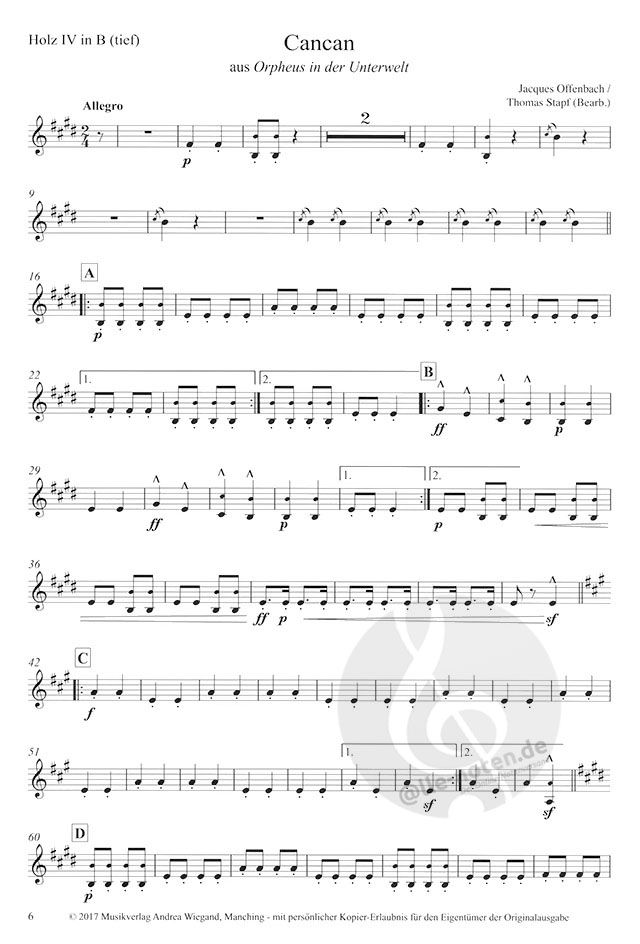
With his Galop Infernal from the second act of his operetta Orpheus in the Underworld (1858 in Paris), Jacques Offenbach gave us what is probably the most famous music ever written to accompany the cancan; in fact, it has long been one of the most popular melodies worldwide. The cancan, a fast French dance in 2/4 time, evolved in Paris around 1830, where it is still today one of the attractions of the music hall Moulin Rouge.
Essential for any performance is first of all a string ensemble but the piece can even be played by the soloists of a string quartet if desired. Apart from Violin I (and the first few bars of the cello), all the parts only require the first position; moreover, the viola can be replaced by a Violin III. An easy part for the violin (using only the first finger pattern) is also provided so that beginners can be included too. The parts are marked with bowing.
Additionally, both a full complement of woodwind (flute, oboe, clarinet, bassoon) and brass instruments (trumpet, horn, trombone) can also join in ad libitum. Timpani, percussion, xylophone, harp and piano put the finishing touches to the symphonic soundscape.
The score is written in C while the parts in the parts book are transposed accordingly.
I clienti hanno valutato questo prodotto:
Musikverlag Andrea Wiegand
Schreinerstr. 8
85077
Manching
Deutschland
Spartiti dal 1969
Dal 1969, oltre 500.000 clienti si fidano di noi. Con un'enorme selezione di oltre 1.000.000 di spartiti, siamo uno dei più grandi fornitori in Europa. Grazie al nostro grande magazzino possiamo spesso spedire gli spartiti entro 24 ore. Qualsiasi spartito stiate cercando: siete nel posto giusto!
La vostra Stefanie Reichert
Responsabile del servizio clienti
Altri clienti hanno acquistato anche:

Bedrich Smetana
- orchestra
- partitura e parti (orchestra)
- Thomas Stapf
-
disponibile
|
sarà spedito in 1-2 giorni lavorativi

- orchestra
- partitura e parti
- Thomas Stapf
-
disponibile
|
sarà spedito in 1-2 giorni lavorativi

- orchestra
- set di parti
- Thomas Stapf
-
disponibile
|
sarà spedito in 1-2 giorni lavorativi

Edward Elgar
- orchestra
- partitura e parti
- Gerhard Buchner
-
disponibile
|
sarà spedito in 1-2 giorni lavorativi

Johann Pachelbel
für Streicher und Bläser mit Schlagwerk und Harfe (Klavier) - Partitur und Stimmenheft
- orchestra
- partitura e parti
- Thomas Stapf
-
disponibile
|
sarà spedito in 1-2 giorni lavorativi

Franz Schubert
- orchestra
- partitura e parti (orchestra)
- Thomas Stapf
-
disponibile
|
sarà spedito in 1-2 giorni lavorativi

Anton Arensky
- orchestra
- partitura e parti
- Victor López
-
disponibile
|
sarà spedito in 1-2 giorni lavorativi
- Disponibile anche per il download!

Antonín Dvořák
- orchestra
- partitura e parti (orchestra)
- Thomas Stapf
-
disponibile
|
sarà spedito in 1-2 giorni lavorativi

Edvard Grieg
- orchestra
- partitura e parti
- Richard Meyer
-
disponibile
|
sarà spedito in 1-2 giorni lavorativi
- Disponibile anche per il download!

- orchestra
- partitura e parti
- Gerhard Buchner
-
disponibile
|
sarà spedito in 1-2 giorni lavorativi

- orchestra
- set di parti
- Thomas Stapf
-
sarà spedito in 2-4 giorni lavorativi


- orchestra
- partitura e parti per scaricare
- Ted Parson
-
immediatamente disponibile
|
Scarica subito dopo l'ordinazione

Songbook
- canzoniere
- spartiti
-
disponibile
|
sarà spedito in 1-2 giorni lavorativi

Das Pop-Chorbuch für die Schule
- coro misto (3-4 parti) e pianoforte
- spartiti
- Carsten Gerlitz Stefan Kalmer
-
disponibile
|
sarà spedito in 1-2 giorni lavorativi

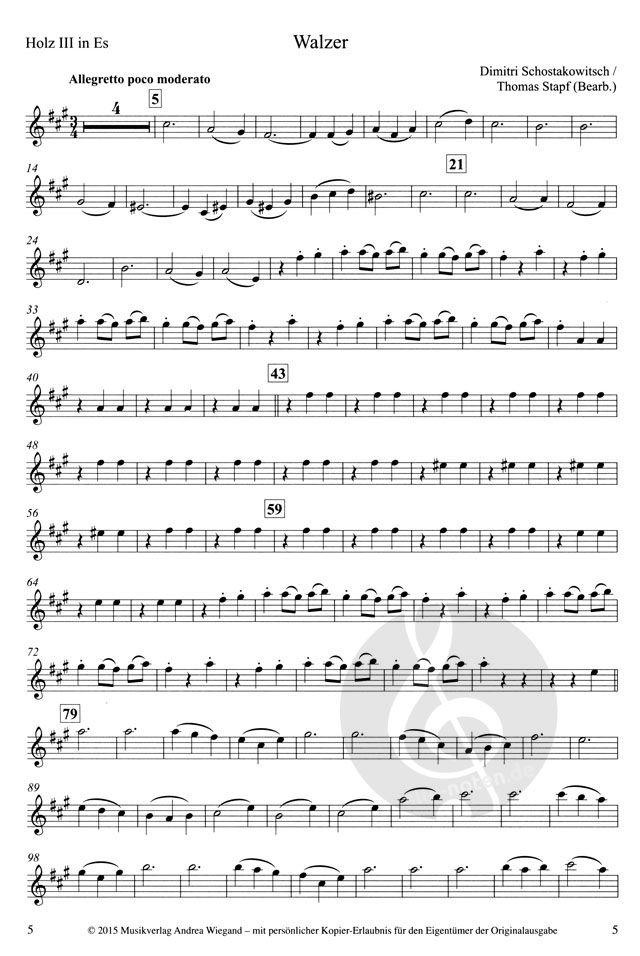
- archi
- parte viola
-
disponibile
|
sarà spedito in 1-2 giorni lavorativi