
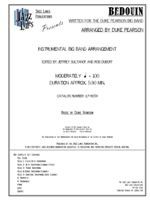
Bedouin
Dimostrazione
ascoltare
PDF
vista
Bedouin
- Formazione orchestra jazz
- Editore Duke Pearson
-
Difficoltà
- Edizione partitura e parti
- Casa Editrice Jazz Lines Publications
- Numero d'ordine JLP-8159
 sarà spedito 2-4 settimani
IVA inclusa,
Escluse le spese di spedizione
Non disponibile in tutti i Paesi. Saperne di più

Descrizione:
Jazz Big Band Arrangement. Full Score, Reed 1: Flute/Alto Saxophone, Reed 2: Alto Saxophone/Clarinet/Flute, Reed 3: Tenor Saxophone, Reed 4:Tenor Saxophone/Clarinet, Reed 5: Baritone Saxophone/Bass Clarinet, 4 Trumpets, 4 Trombones, Piano, Bass, Drums
A recording of 'Bedouin' appeared on Duke Pearson's first big band album. The chart was heavily edited for this recording, with a board fade during an improvised solo. In fact, this piece existed in two different versions; the one recorded was version 2. 'Bedouin' turns out to be a beautiful, unusual composition. It is always an unexpected pleasure to find a 'new' piece of music because the 'old' one was not recorded in its entirety, particularly one from such an underrated composer such as Pearson. This piece has a little of everything: woodwind doubles, brass in various mutes, and time signature changes. Yet this is not a difficult composition to play, and can be opened up for solos. Because there are parts of the piece where different mutes are used for each member of the brass, and there are mixed woodwinds, balance is a particular issue; each part should blend with the rest of the section, and individuals should compensate accordingly. If amplification is used, be careful so that no one individual section or part is emphasized. Ranges: Trumpet 1: C#6 Trombone 1: B4
A recording of 'Bedouin' appeared on Duke Pearson's first big band album. The chart was heavily edited for this recording, with a board fade during an improvised solo. In fact, this piece existed in two different versions; the one recorded was version 2. 'Bedouin' turns out to be a beautiful, unusual composition. It is always an unexpected pleasure to find a 'new' piece of music because the 'old' one was not recorded in its entirety, particularly one from such an underrated composer such as Pearson. This piece has a little of everything: woodwind doubles, brass in various mutes, and time signature changes. Yet this is not a difficult composition to play, and can be opened up for solos. Because there are parts of the piece where different mutes are used for each member of the brass, and there are mixed woodwinds, balance is a particular issue; each part should blend with the rest of the section, and individuals should compensate accordingly. If amplification is used, be careful so that no one individual section or part is emphasized. Ranges: Trumpet 1: C#6 Trombone 1: B4
I clienti hanno valutato questo prodotto:
Informazioni del Produttore:
Jazz Lines Publ.
PO Box 1236
NY 12866
Saratoga Spgs
Vereinigte Staaten
Altri clienti hanno acquistato anche:

- orchestra jazz
- partitura e parti
- Bill Holman
-
sarà spedito in 2-4 giorni lavorativi

- orchestra jazz (solo: sassofono contralto)
- partitura e parti
-
sarà spedito 2-4 settimani
- orchestra jazz
- partitura e parti
- Ernie Wilkins
-
sarà spedito 2-4 settimani


- orchestra jazz
- partitura e parti
- Duke Pearson
-
sarà spedito 2-4 settimani

- orchestra jazz
- partitura e parti
- Ernie Wilkins
-
sarà spedito in 2-4 giorni lavorativi
- orchestra jazz
- partitura e parti
- Duke Pearson
-
sarà spedito 2-4 settimani

Tadd Dameron
- orchestra jazz (solo: tromba)
- partitura e parti
- Bill Holman
-
sarà spedito 2-4 settimani

- orchestra jazz
- partitura e parti
- Bill Holman
-
sarà spedito 2-4 settimani
- orchestra jazz
- partitura e parti
- Ernie Wilkins
-
sarà spedito 2-4 settimani

Stan Kenton
- orchestra jazz
- partitura e parti
- Stan Kenton
-
sarà spedito 2-4 settimani
- orchestra jazz
- partitura e parti
- Duke Pearson
-
sarà spedito 2-4 settimani
- orchestra jazz
- partitura e parti
- Duke Pearson
-
sarà spedito 2-4 settimani