
Antonín Dvořák
String Quartet No. 12 in F Major, Op. 96 (American) for Woodwind Quintet
The New York Woodwind Quintet Library Series
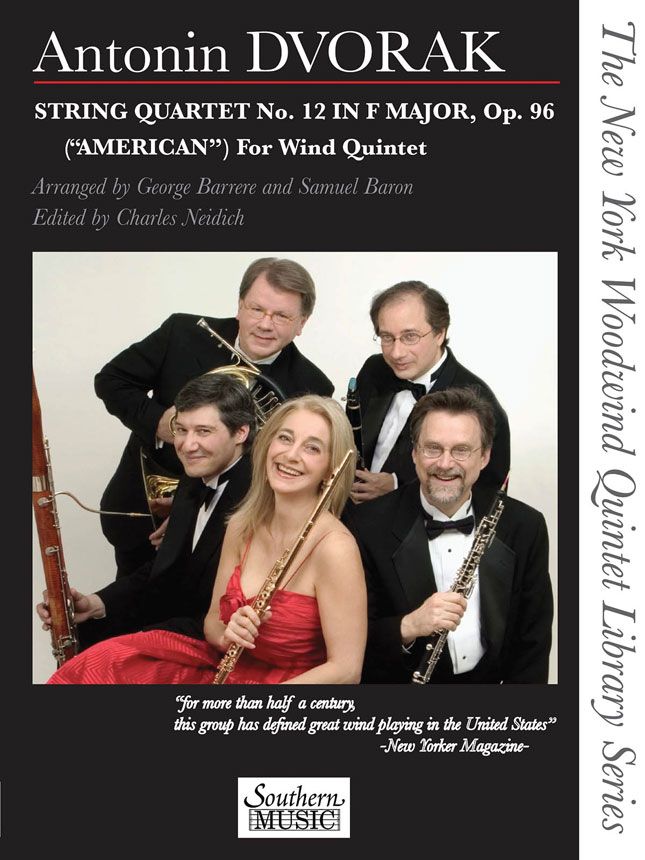
Antonín Dvořák
String Quartet No. 12 in F Major, Op. 96 (American) for Woodwind Quintet
The New York Woodwind Quintet Library Series
- Formazione flauto traverso, oboe, clarinetto, corno e fagotto
- Compositore Antonín Dvořák
- Serie Southern Music Woodwind
- Edizione partitura e parti
- Casa Editrice Southern Music Company
- Numero d'ordine SMC-SU781
 sarà spedito in 3-6 giorni lavorativi
IVA inclusa,
Escluse le spese di spedizione
Non disponibile in tutti i Paesi. Saperne di più
Descrizione:
Antonin Dvorak composed the quartet in F Major, op. 96 'The American' in the summer of 1893 during his summer vacation in Spillvale, Iowa. From 1892-1895, Dvorak served as director of the National Conservatory of Music in NYC. He had been interested in 'American Music' and felt that Native American and Afro-American music could inspire an 'American Music' distinct from European influences. He was inspired by (Henry Thacker) Harry Burleigh, his student in New York and one of the first Afro-American composers.
While it is impossible to know why Georges Barrere chose Dvorak's F Major Quartet to transcribe for Woodwind Quintet, we may easily hazard several guesses. Firstly, it was a work much beloved by the public and very respected by professional musicians. As an immigrant himself, Barrere could easily sympathize with Dvorak's desire to create a distinctly American work. A work in the key of F Major, it lent itself easily to wind transcription. While known as the Barrere transcription, it turns out that Samuel Baron, one of Barrere's most famous students and a long time member of the New York Woodwind Quintet, who has to his credit a long list of wonderful transcriptions for woodwind quintet, played a significant role in the transcription.
While it is impossible to know why Georges Barrere chose Dvorak's F Major Quartet to transcribe for Woodwind Quintet, we may easily hazard several guesses. Firstly, it was a work much beloved by the public and very respected by professional musicians. As an immigrant himself, Barrere could easily sympathize with Dvorak's desire to create a distinctly American work. A work in the key of F Major, it lent itself easily to wind transcription. While known as the Barrere transcription, it turns out that Samuel Baron, one of Barrere's most famous students and a long time member of the New York Woodwind Quintet, who has to his credit a long list of wonderful transcriptions for woodwind quintet, played a significant role in the transcription.