
Ferruccio Busoni
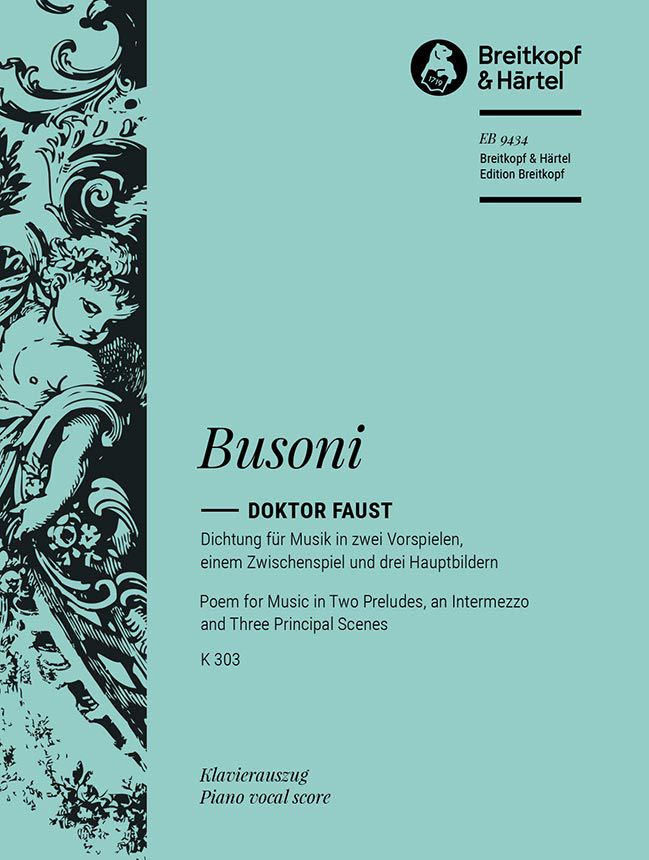
Doktor Faust K 303
Poem for Music in 2 Preludes, an Intermezzo and 3 Principal Scenes
PDF
vista
Ferruccio Busoni
Doktor Faust K 303
Poem for Music in 2 Preludes, an Intermezzo and 3 Principal Scenes
- Formazione solisti, coro misto (SSAATTBB) e pianoforte
- Compositore Ferruccio Busoni
- Edizione riduzione per pianoforte
- Casa Editrice Breitkopf & Härtel
- Numero d'ordine EB9434
 disponibile
sarà spedito in 1-2 giorni lavorativi
IVA inclusa,
Escluse le spese di spedizione
Non disponibile in tutti i Paesi. Saperne di più
Descrizione:
Duration: full evening
Text by the composer based on the eponymous puppetry
Translation: French (J. Lasserre), Italian (O. Previtali)
Place and time: Wittenberg and Parma, late Middle Ages
Characters: Doktor Faust (baritone) – Wagner, sein Famulus (baritone) – Mephistopheles (tenor) – Der Herzog von Parma (tenor) – Der Zeremonienmeister (bass) – Die Herzogin von Parma (soprano) – Des Mädchens Bruder, Soldat (baritone) – Ein Leutnant (tenor) – Drei Studenten aus Krakau (tenor, 2 Bässe) – Theologe (bass) – Jurist (bass) – Naturgelehrter (baritone) – Vier Studenten aus Wittenberg (4 Tenors) – Gravis (bass) – Levis (bass) – Asmodus (baritone) – Beelzebuth (tenor) – Megäros (tenor) – Kirchgänger, Soldaten, Hofleute, katholische und lutherische Studenten (Chor)
"Doktor Faust" is not only Busoni’s "Opus summum” from a chronological point of view; it also evidences traces of many earlier scores which the composer brought together here under the primacy of musical theater which led, as it were, to an objectification of many scenes. Antony Beaumont’s completion of the two scenes left in fragmentary form was based on Busoni’s composition sketches and a detailed dramaturgical outline. This version has made a decisive contribution to the renewed interest in the work. The score is also available in a new version prepared after a critical study of the source material.
Text by the composer based on the eponymous puppetry
Translation: French (J. Lasserre), Italian (O. Previtali)
Place and time: Wittenberg and Parma, late Middle Ages
Characters: Doktor Faust (baritone) – Wagner, sein Famulus (baritone) – Mephistopheles (tenor) – Der Herzog von Parma (tenor) – Der Zeremonienmeister (bass) – Die Herzogin von Parma (soprano) – Des Mädchens Bruder, Soldat (baritone) – Ein Leutnant (tenor) – Drei Studenten aus Krakau (tenor, 2 Bässe) – Theologe (bass) – Jurist (bass) – Naturgelehrter (baritone) – Vier Studenten aus Wittenberg (4 Tenors) – Gravis (bass) – Levis (bass) – Asmodus (baritone) – Beelzebuth (tenor) – Megäros (tenor) – Kirchgänger, Soldaten, Hofleute, katholische und lutherische Studenten (Chor)
"Doktor Faust" is not only Busoni’s "Opus summum” from a chronological point of view; it also evidences traces of many earlier scores which the composer brought together here under the primacy of musical theater which led, as it were, to an objectification of many scenes. Antony Beaumont’s completion of the two scenes left in fragmentary form was based on Busoni’s composition sketches and a detailed dramaturgical outline. This version has made a decisive contribution to the renewed interest in the work. The score is also available in a new version prepared after a critical study of the source material.