
Béla Bartók
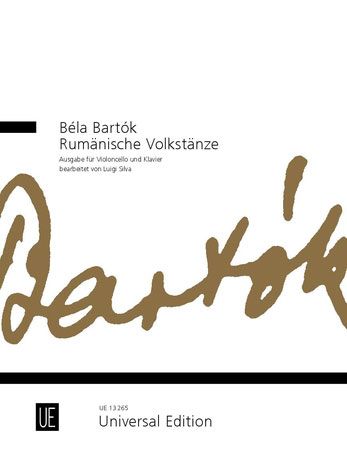
Romanian Folk Dances (Arr. for Cello and Piano)
PDF
vista
Béla Bartók
Romanian Folk Dances (Arr. for Cello and Piano)
- Formazione violoncello e pianoforte
- Compositore Béla Bartók
- Editore Luigi Silva
-
Difficoltà
- Edizione spartiti
- Casa Editrice Universal Edition
- Numero d'ordine UE13265
 disponibile
sarà spedito in 1-2 giorni lavorativi
IVA inclusa,
Escluse le spese di spedizione
Non disponibile in tutti i Paesi. Saperne di più

Descrizione:
The 'Romanian Folk Dances' undoubtedly rank amongst Bartók's most popular compositions. The earliest version is scored for piano (1915) and was published by Universal Edition in 1918. The composer himself orchestrated this version in 1917. Several other chamber music arrangements (for example, Zoltán Székely's version for violin and piano) were not by Bartók, although he authorised them.
The musical material derives from Bartók's collections of folk music, which date right back to 1904, when he wrote down a melody sung by a Hungarian peasant girl. In the course of extensive travels throughout Eastern Europe, Bartók compiled an enormous collection of folk tunes (by 1918 his collection comprised no fewer than 2700 Hungarian, 3500 Romanian and 3000 Slovak dances and songs) which would in all probability have been lost had Bartók not written them down. As it was, some of them found their way into his compositions. In 1908 Bartók jotted down dance tunes in Transsylvania. They are the source of the 'Romanian Folk Dances'. (R.K.,from the preface)
The musical material derives from Bartók's collections of folk music, which date right back to 1904, when he wrote down a melody sung by a Hungarian peasant girl. In the course of extensive travels throughout Eastern Europe, Bartók compiled an enormous collection of folk tunes (by 1918 his collection comprised no fewer than 2700 Hungarian, 3500 Romanian and 3000 Slovak dances and songs) which would in all probability have been lost had Bartók not written them down. As it was, some of them found their way into his compositions. In 1908 Bartók jotted down dance tunes in Transsylvania. They are the source of the 'Romanian Folk Dances'. (R.K.,from the preface)
I clienti hanno valutato questo prodotto:
Informazioni del Produttore:
Universal Edition AG
Karlsplatz 6
1010
Wien
Österreich
Altri clienti hanno acquistato anche:

Sebastian Lee
- violoncello
- spartiti
-
disponibile
sarà spedito in 1-2 giorni lavorativi - Disponibile anche per il download!

Serge Koussevitzky
- contrabbasso e orchestra
- spartiti
-
disponibile
sarà spedito in 1-2 giorni lavorativi - Disponibile anche per il download!

- contrabbasso e orchestra
- spartiti
- Konrad Siebach
-
disponibile
sarà spedito in 1-2 giorni lavorativi

Michael Jackson
- coro misto (SATB)
- partitura corale
- Mark Brymer
-
disponibile
sarà spedito in 1-2 giorni lavorativi - Disponibile anche per il download!

- violoncello e pianoforte
- riduzione per pianoforte con solo/i
-
disponibile
sarà spedito in 1-2 giorni lavorativi
- violoncello e pianoforte
- partitura per pianoforte e parte/i
-
sarà spedito in 4-8 giorni lavorativi

Julius Klengel
- violoncello e pianoforte
- spartiti
-
disponibile
sarà spedito in 1-2 giorni lavorativi
- violoncello e pianoforte
- spartiti
-
disponibile
sarà spedito in 1-2 giorni lavorativi

- violoncello e basso continuo
- spartiti
-
disponibile
sarà spedito in 1-2 giorni lavorativi - Disponibile anche per il download!
- violoncello e pianoforte
- spartiti
-
sarà spedito in 3-6 giorni lavorativi

Gioacchino Rossini
- violoncello e pianoforte
- spartiti
-
sarà spedito in 4-8 giorni lavorativi

- violoncello e pianoforte
- spartiti
-
disponibile
sarà spedito in 1-2 giorni lavorativi - Disponibile anche per il download!


Ludwig van Beethoven
with marked and unmarked violoncello parts
- violoncello e pianoforte
- spartiti (urtext)
- David Geringas
-
disponibile
sarà spedito in 1-2 giorni lavorativi

Jean Sibelius
- violino e pianoforte
- spartiti
-
sarà spedito in 3-6 giorni lavorativi

- violoncello e pianoforte
- spartiti
- Pierre Fournier
-
disponibile
sarà spedito in 1-2 giorni lavorativi